The round, the letters,
the list. Done by lunch.
Post-MI reviews, titration, device checks. Said once, drafted in full.
Day two after a non-ST-elevation myocardial infarction.
What aurii captures as you say it, problem by problem.
-
Open the patient and run the overnight
Day two post-NSTEMI. You note the overnight: no recurrence of chest pain, stable observations, a settled troponin trend; aurii listens and structures against the problem as you speak.
-
Read the numbers and the tracing
The morning ECG, the trop result, renal function and potassium before the ACE inhibitor, the echo still pending. You dictate what you see; aurii attaches each finding to its problem, not a flat list.
-
Titrate and state the plan
Up-titrate the beta-blocker, start the ACE inhibitor low and recheck renal function, continue dual antiplatelet and statin, wean the GTN, await the echo before the angiography decision; aurii separates today's assessment from the plan for each problem.
-
Review and sign before the next bed
The progress note is drafted in front of you. You correct anything, then sign. Nothing is filed until you do, and the referrer letter, the discharge and the billing all draw from the same signed review.
Drafted before the next bed.
One spoken review, the full set of cardiology documents, each a draft until you sign it.
Where the draft lives until you sign.
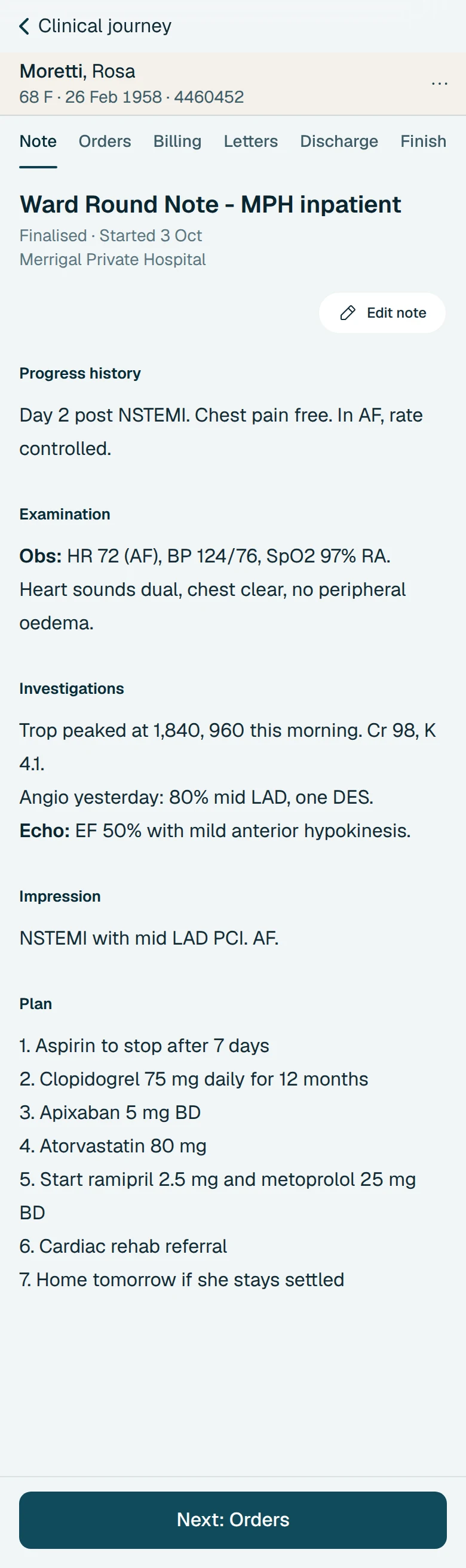
The note opens for review the moment you finish speaking. This is the desktop review view, shown on a general demo note.
A real aurii screen, shown on a general demo note.
A day-two post-NSTEMI progress note.
The round above, played out on a synthetic patient: each spoken line lands in the note as you say it, problem by problem. Yours to correct and sign.
"Day two after the NSTEMI. No chest pain overnight, obs stable, nothing on telemetry, and the GTN infusion came off overnight."
"Trop has peaked and is trending down, and this morning's ECG shows the anterolateral changes resolving, nothing new. Continue dual antiplatelet and the high-intensity statin, echo before the angiography decision."
"JVP's not up, chest is clear, trace of peripheral oedema, so she's euvolaemic. Start the ACE inhibitor low, and recheck renal function and potassium in forty-eight hours before we up-titrate."
"Her AF is rate controlled. Keep up-titrating the beta-blocker as tolerated, and anticoagulation continues per the admission plan."
"Echo today please, and repeat renal function and electrolytes in forty-eight hours."
"Refer her to cardiac rehab, and a letter to the referring GP on discharge with the reconciled medication list."
Overnight
No recurrence of chest pain. Haemodynamically stable, no arrhythmia on telemetry. GTN infusion weaned overnight and ceased.
Problem 1 · NSTEMI
Troponin peaked and now trending down. ECG this morning shows resolving anterolateral changes, no new deviation. Continue dual antiplatelet and high-intensity statin. Awaiting inpatient echo before the angiography decision.
Problem 2 · Heart failure, mild
JVP not elevated, chest clear, trace peripheral oedema. Euvolaemic on examination. ACE inhibitor started at a low dose. Recheck renal function and potassium in 48 hours before up-titration.
Problem 3 · Rate and rhythm
Background atrial fibrillation, rate controlled. Beta-blocker up-titrated as tolerated. Anticoagulation continued per admission plan.
Plan
- Echo today
- Renal function and electrolytes in 48 hours
- Cardiac rehabilitation referral
- Referrer letter to the referring GP on discharge with the reconciled medication list
A documentation tool, not a diagnostic device: aurii drafts billing items for your review against the episode and your fund agreements; it does not decide what is claimable or set fees. You confirm every item before anything is billed.
Built around the letter after every visit.
Cardiology runs on correspondence. The note and the letter are done while the patient is in front of you, not after the list.
- Signed Sign at the bedsideThe note is ready the moment you finish. You sign it there, with the trace and numbers in front of you, so correspondence does not pile up overnight.
- Same day The letter goes the day you saw themBecause the referrer letter draws from the signed note, it goes out the day of the visit, not a week later. The referring GP hears back while the plan still matters.
- Tracked Medication changes tracked across the stayEach day's dose change feeds the record, so the discharge list reconciles what actually happened over the admission, not rebuilt from memory at the end.
- Delivered Delivered to the GP's inboxLetters and the discharge can be delivered over HL7 v2 with Medical Objects connectivity, with delivery acknowledgements tracked back per letter, so you can see it landed.
The cardiology questions.
Four things clinicians ask before they run a list with aurii. The full set lives on the FAQ.
It drafts from how you already talk through a patient, so the round's language (trop trend, beta-blocker up-titration, GTN weaning, echo pending) lands as you say it. Drafts can be wrong, which is why nothing is filed until you read and sign. You correct it first; every version is kept in the audit trail. We will not quote an accuracy figure. See how it behaves on the ward.
The engine is general; the templates are shaped to your round during setup: the problem-by-problem note, the referrer letter after every private review, the discharge with medications reconciled. There is no cardiology-only model, just your artefacts, built to how you work.
There is no connection to imaging or physiology systems. Results arrive by upload and extraction; you reference them in the note as you review them. Letters go out over HL7 v2 with delivery acknowledgements tracked back per letter; there is no live results feed inbound. See how delivery works.
Capture keeps working offline and syncs when you are back in range, so a dead spot on the ward does not cost you the review. Nothing is committed until it syncs and you sign. More in on the ward.
Run a cardiology list with aurii.
Bring a typical round or a clinic. We'll show you the note, the referrer letter, the discharge and the billing, and where you review and sign.
A$199 + GST / clinician / month no lock-in early access by request
hello@aurii.com.au