Every problem, on one round.
The multi-problem admission, kept straight as you talk.
On the ward round.
A typical review on a general-medicine ward, and what aurii captures as you say it.
-
Open the patient and start talking
An older patient admitted with community-acquired pneumonia, on a background of heart failure and type 2 diabetes. You note overnight events, observations and the oxygen requirement; aurii structures as you speak.
-
Work problem by problem
The pneumonia and antibiotic day, the fluid balance and heart failure, glycaemic control, renal function and electrolytes; aurii keeps each active problem as its own thread, so the picture stays legible.
-
State the plan per problem
Continue the antibiotics, gently offload, hold or adjust medications, repeat the bloods, and the discharge criteria you're working toward; aurii pairs each plan with its problem.
-
Review and sign before you leave the bed
The progress note is drafted in front of you, problem by problem. You correct anything, then sign. Nothing is filed until you do. The letter, discharge and billing all draw from the same signed update.
What aurii drafts.
One spoken review, the full set of medical documents. Each is a draft until you sign it.
The note, drafted from one spoken review.
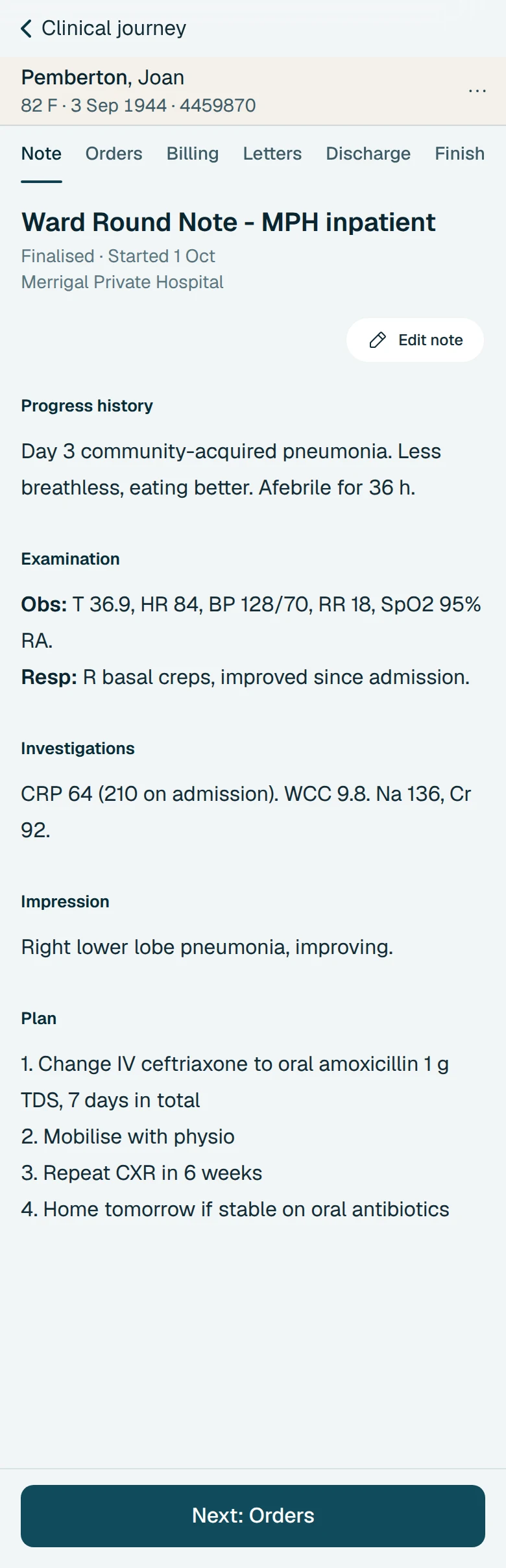
The daily note aurii drafts from one spoken general-medicine review, yours to correct and sign.
A real aurii note, shown on a demo patient.
The problem-by-problem note, drafting itself.
A multi-problem review as it plays: the round is spoken and each problem drafts with its own assessment and plan as you say it. Worked example on a synthetic patient, not a real record.
"Day three of the pneumonia. She settled overnight, afebrile, and her sats are 95 now we've weaned the oxygen down to one litre on the nasal prongs."
"Chest still has reduced air entry at the right base, no new crackles. She's warm and well perfused, JVP isn't up, the oedema is improving."
"CRP is falling, so step down to oral amoxicillin-clavulanate to finish the course, and keep the chest physio going."
"Heart failure wise she's down 1.2 kilos on the frusemide. Keep the dose, daily weights, strict fluid balance, and no more IV fluids."
"She's eating again, so restart her metformin and keep the SGLT2 inhibitor held. Sugars have been nine to twelve, we'll review before she goes home."
"Creatinine is stable, potassium 4.1, repeat the bloods tomorrow. Once the antibiotics are done and she's off the IV, draft the discharge and the GP letter."
Overnight & on examination
Settled overnight, afebrile. Saturations 95 percent, weaned to 1L nasal prongs. Reduced air entry at the right base, no new crackles. Warm and well perfused, JVP not elevated, oedema improving.
1 · Community-acquired pneumonia
Day 3 of treatment. CRP falling, oxygen requirement reducing. Step down from IV to oral amoxicillin-clavulanate to complete the course. Chest physiotherapy to continue.
2 · Chronic heart failure
Fluid status improving on gentle diuresis, weight down 1.2 kg. Continue current frusemide dose. Daily weights and strict fluid balance. Withhold further IV fluids.
3 · Type 2 diabetes
Restart usual metformin now oral intake is established. Hold the SGLT2 inhibitor. Capillary glucose 9 to 12 during the acute illness. Review glycaemic control before discharge.
Renal & electrolytes
Creatinine stable, potassium 4.1. Repeat urea, electrolytes and creatinine tomorrow given the diuresis.
Plan toward discharge
- Complete the oral antibiotic course
- Confirm stable off IV therapy
- Discharge summary and GP letter drafted for review
A documentation tool, not a diagnostic device: aurii drafts notes and billing items for your review; it does not diagnose, decide medication changes or decide what is claimable. You confirm every change and every item before anything is filed or billed.
Built around a busy list.
A general-medicine round is long and the patients complex, so review-and-sign has to fit between beds, not at the end of the day.
- Signed Signed at the bed, while the plan is freshThe note is ready the moment you finish speaking, so you sign it there, problem by problem, each plan as you intended. The paperwork for a twenty-patient list does not wait for you at 8pm.
- Threaded The problem list stays straightEach active problem keeps its own thread across the admission, so a long stay never blurs into one block of text. Every issue carries its own assessment and plan.
- Discharge A discharge that's mostly doneEach day's signed note and the running medication reconciliation feed the discharge, so the summary is mostly written by the time the patient is ready. You finish the follow-up and sign.
- Delivered The letter lands in the practice inboxSigned letters and discharges can be sent over HL7 v2 through Medical Objects, landing in the referring practice's inbox with delivery acknowledgement tracked back against the letter. No printing, no fax tray.
The general-medicine questions.
The four questions physicians ask before they trust it with the round.
Everything aurii hears becomes a draft, nothing more; it does not file anything. You read the note problem by problem, correct what's off, then sign. Only then is it kept. Every version is retained in the audit trail, so an edit is traceable, not silent. We will not quote an accuracy figure, because the safeguard is not the transcription, it is that a named clinician reviews and signs before anything leaves the bedside. More on the clinical safety page.
The structure, the sections you want and the order you work in are set during onboarding, not left to a generic default. As you edit drafts, aurii follows how you phrase an assessment and plan. You are shaping a template to your round, not training a model on your patients. The full set is on the FAQ.
Capture works offline. You record and draft the review with no connection, and the encounter syncs when you are back in range, without creating a duplicate. Nothing is lost because the lift dropped out between beds. See the FAQ.
Signed letters and discharges can be delivered over HL7 v2 through Medical Objects, so they arrive in the referring practice's inbox rather than a fax tray, with the delivery acknowledgement tracked back against the letter. How delivery works, and what reaches which systems, is on integrations.
Run a round with aurii.
Sign before you leave the ward.
Bring a typical multi-problem admission. We'll show you the problem-by-problem note, the medication reconciliation, the letters, the discharge and the billing, and where you review and sign.
A$199 + GST / clinician / month no lock-in early access by request
hello@aurii.com.au