The GP letter,
with a worked example.
The letter back to the GP, drafted from your review and tracked after you sign.
What the GP letter template lays down.
These are the section headings the shipped GP letter template installs, in order. Read it as the outline of a specialist-to-GP letter: why the patient was seen, what you found, what you think, what you did, and what the GP does next. At setup, order and wording follow your house style.
-
Addressee and patient header
Addressed to the GP by name, with patient identifiers, date of birth and review date carried straight from the record. You do not retype the demographics, so the letter cannot disagree with the file it came from.
-
Reason for the review
One or two lines on why the patient was seen: the referral question, the presenting problem, or the scheduled follow-up. The GP reads this first, so it sits first.
-
Relevant history and background
The history that matters here: active problems, pertinent past history, current medications and allergies, summarised rather than dumped.
-
Examination and investigations
Examination findings on the day and the results that informed the assessment, with the numbers a GP wants rather than a bare 'bloods reviewed'.
-
Impression
Your diagnosis or working impression, in your words. The template only holds its place; the clinical judgement is yours and stays yours.
-
Management and plan
What was done and what happens next: investigations ordered, treatment started or adjusted, and the reasoning stated plainly enough to act on.
-
Medication changes
The changes called out on their own: what was started, stopped or altered, and why. Reconciled against the medications on record so nothing is dropped silently.
-
Actions for the GP
The explicit ask: what you want the GP to do, monitor or follow up, and when. It turns a letter into a closed loop, not a filing.
-
Follow-up and safety-netting
When you will see the patient again, the results still pending, and the red flags to return on. The reader knows who holds each next step.
-
Sign-off
Your name, role and provider details as they appear on your other correspondence. Nothing goes out until you review the full letter and sign it.
The spine is the same for the routine and urgent GP letters; the urgent variant puts the urgency line where the reader cannot miss it. A template controls the shape of the document, nothing more: the impression and the plan are yours.
The template, drafting itself.
The shipped template doing its job. A cardiologist speaks the review, and the letter to the GP assembles itself beside the words, section by section. A worked example on a demo record, not a real patient.
"Letter to Dr Ellery please. Routine review of her persistent atrial fibrillation, rate control and anticoagulation."
"She's well today, no dyspnoea. Pulse 74, irregularly irregular, blood pressure 128 over 78, chest clear, no oedema."
"ECG still shows AF with a controlled rate. Recent echo had preserved LV function, renal function and electrolytes normal."
"So, rate controlled and appropriately anticoagulated, no heart failure. Bisoprolol and apixaban continue unchanged."
"Ask the GP to keep monitoring blood pressure and renal function. I'll see her in twelve months, sooner if palpitations worsen or there's any bleeding."
Re
Dear Dr Ellery, re your patient, seen today for routine review of persistent atrial fibrillation, rate control and anticoagulation.
Examination and investigations
Well, no dyspnoea. Pulse 74 and irregularly irregular, blood pressure 128 over 78, chest clear, no oedema. ECG confirms atrial fibrillation with a controlled ventricular rate. Recent echocardiogram shows preserved left ventricular function. Renal function and electrolytes normal.
Impression
Persistent atrial fibrillation, rate controlled and appropriately anticoagulated. No heart failure.
Medication changes
No changes this visit. Bisoprolol and apixaban continue at current doses.
Actions for the GP
- Please continue to monitor blood pressure and renal function
- Cardiology review in twelve months, sooner if palpitations worsen or there is any bleeding
Drafted in your voice, tracked after you sign.
The template above is not a document you fill in by hand; aurii drafts the letter from your spoken review, holds it for your signature, and follows it after it leaves.
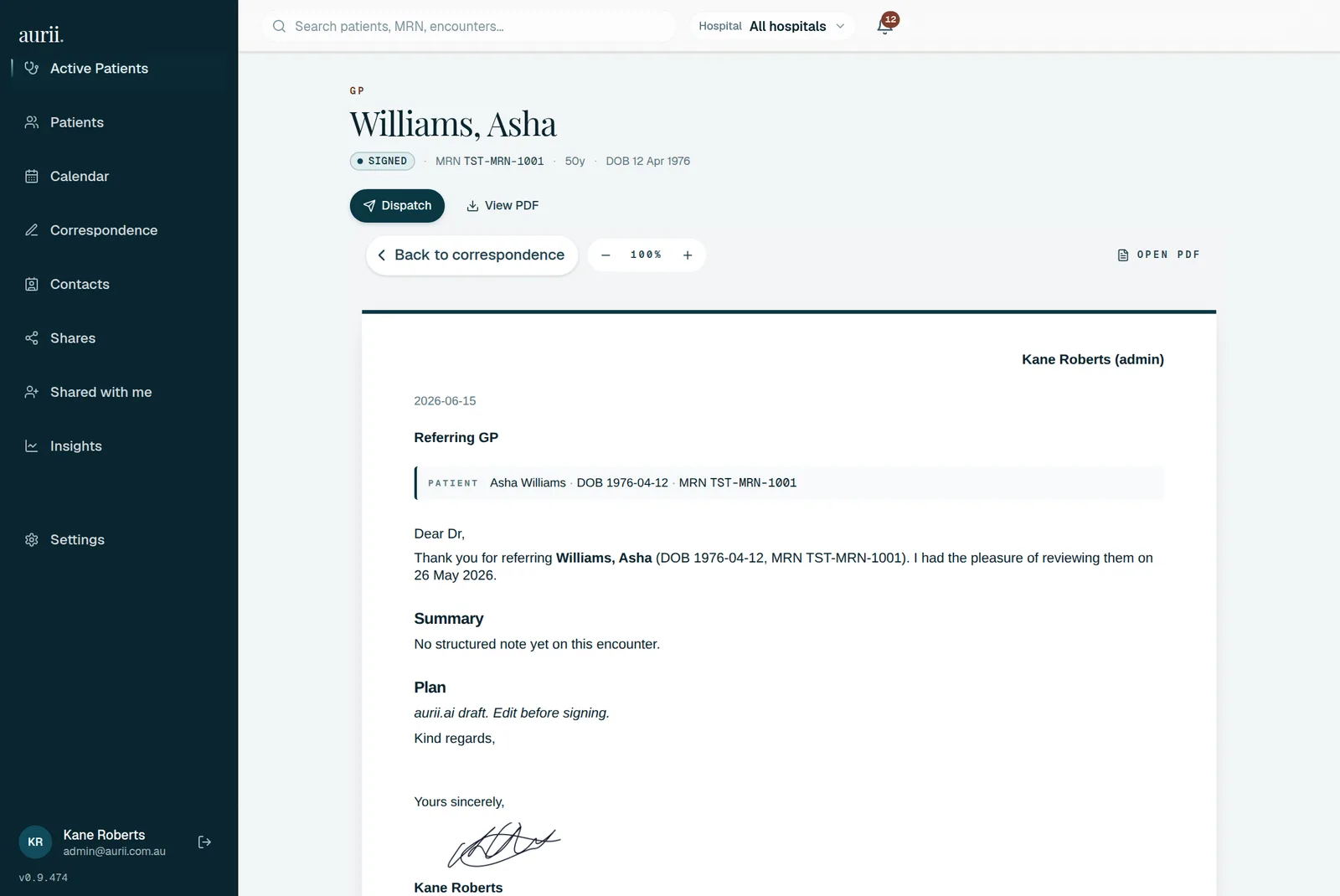
A GP letter in aurii, shown on a demo patient. The draft waits on your sign-off screen; the delivery record starts once you sign.
- At setup Shaped to your voice. During setup the template is shaped to how you write: your section order, your phrasing, your sign-off. The first letter on your review screen already reads like you wrote it, so review is a read and a signature, not a rewrite.
- Addressing Addressed from the record. The addressee, patient identifiers and dates are carried from the patient file, not retyped. The letter cannot disagree with the record it was drafted from, and you correct anything on screen before you sign.
- Delivery Delivered, and acknowledged. After you sign, the letter can be delivered as HL7 v2 through Medical Objects so it reaches the right Australian practice inbox. The delivery acknowledgement is recorded against the correspondence, so you can see it landed. More on the delivery paths.
- Sign-off Nothing goes out unsigned. The letter stays a draft until a named clinician reviews and signs it; aurii proposes the document, and you remain responsible for the clinical content and for what goes out in your name. Every version and every send is written to a tamper-evident audit trail.
Three questions, answered.
What clinicians actually search for. Educational, not clinical or medico-legal advice.
A useful specialist-to-GP letter answers the referral question and tells the GP what to do next. In practice: the reason for the review, the relevant history and examination, the investigations and results, your impression, the management plan, medication changes called out clearly, and an explicit list of what to monitor or follow up. The shipped aurii template lays those sections in that order, and you shape the order and wording to your house style at setup.
For the wider expectations on clinical correspondence and safe use of AI scribes, the RACGP guidance on AI scribes is the reference we design to. This page is educational and is not clinical or medico-legal advice.
No. Every letter is a draft until a named clinician reviews and signs it; aurii drafts the letter from your spoken review and holds it on your sign-off screen, and nothing is addressed, sent or filed until you sign. After you sign, the letter can be delivered to the practice as HL7 v2 through Medical Objects so it lands in the right Australian inbox rather than a fax tray. The delivery acknowledgement is recorded against the correspondence. Drafting and delivering documents is all aurii does; it does not make clinical decisions and it is not a medical device.
Yes. The GP letter template is a working object, not a fixed form. During setup it is shaped to how you write. You can duplicate it, edit it and set your own default. Your version lives inside your practice's own encrypted tenancy, so your changes stay yours. If you need a letter type aurii does not ship, building it is part of setup, not a paid extra.
Your letters, in your shape.
Request access, bring a typical clinic review, and the GP letter template is shaped to how you write before you sign your first one. See the full template set, or how aurii runs for your specialty.
hello@aurii.com.au